

I don't want to be a vlogger
Between you and me can either be distance, an algorithm, or a notification.

Here’s the link upfront: https://www.nodehaus.co/venfluencer
Read on for why I’m asking you to sign up.
Social media. What is it?
It’s a programmed feed built around addiction and advertising. TikTok’s biggest competitor is not Instagram or YouTube — it’s sleep. This is a cynical description, but it’s the reality — you can rapidly switch between the YouTube, Instagram, Reddit, TikTok apps all day, but once you close your eyes, everyone loses (except you).
And this is the media landscape I find myself in. I thought I would make movies since I was a 5th grader making stop-motion animations with my LEGO blocks, then YouTube sketches as a middle-schooler, and then finally getting to film school during the race to streaming. I wanted to move people in the same way movies have moved me.
Instead, I’m living in a weird paradigm where conscious decision-making on the part of the audience is bring replaced by an algorithm. The algorithm is meant to give us what we really want (click-rate), what we actually spend time watching (retention), what’s actually engaging (engagement metrics).
Fortunately or unfortunately, that’s where the money is.
In 2016, Rhett and Link appeared on The Tonight Show. The comedy duo that represented the rise of internet culture was going to be on the new face of late-night tv — and there was a question of who needed who more? Was the heavyweight of linear television there to signal boost the internet duo or was the internet duo juicing the dinosaurs of yesteryear?
To me, this was the turning point. Before that point, entertainment was built around conscious, human decision. This was an eco-system built around a handshake between the TV programmer saying “I believe you will enjoy my programming choices,” and the audience saying, “I trust you to entertain me.”
After this point, it has increasingly become an eco-system of subconscious attention-monetization. It’s not about conscious decision-making, like when you sit and plan out an evening by looking through movie reviews and deciding to go to this specific movie based on the story, the cast, the key art, etc. This is an era based on whatever the suggestion feed, in its supposed omniscience, will give you based on what it has learned about you from your micro—decisions in the app.
When NODEHAUS produced TikToks for several clients, we graphed all of the available engagement and retention data points we could get our hands on and found that the success of a video (reached audience) had the strongest correlation with the Average Watch Time as a percentage of the Total Runtime. Nothing else came close.
And even more concerning, the audience that our content was delivered to was not at all based on whether they followed us — it was based on the audience user’s profile of likes and dislikes learned by the platform. You, making a conscious decision to say “I want to follow this creator” meant very little to this algorithm — your subconscious decisions meant far more.
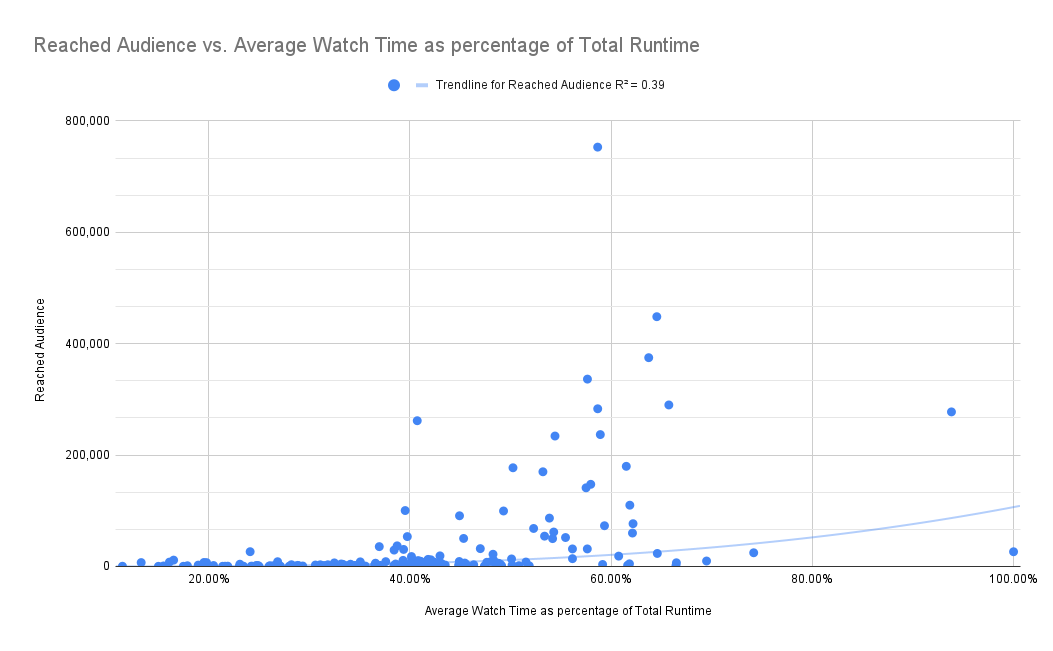
The realization we made was that this platform wants us to brain-hack our audience. People don’t consciously preview or click on anything — they just get handed a video that scratches some kind of itch or tickles a certain fancy about something, and then they swipe to the next video the moment it doesn’t continue doing it for them. Was it going to be the colors we use, or the hair style or the vocal inflection, or the x, y or z of 1, 2 or 3 at every possible moment? On and on.
Every social media platform has moved in this direction — you are given content from feeds you never once consciously followed, and the pages you have followed, you get very little of. Instead, it’s based on what the algorithm assumes about you based on your gender, age, location, political leanings, recent Google searches, retention on previous content, etc. It eschews what you believe you want and, instead, gives you what it believes you want.
And this posits a critical question for everyone: are you able to practice conscious control over what you consume? How often? Is it a 50/50 split or is it more like a once a week kind of thing? How little control do you have as an audience member?
I have to deal with the inverse of this equation: how do I, as someone who believes I can reach, touch and move audiences with my work, actually reach audiences?
A new generation of filmmakers is rising and they’re championed by this group called “Camp Studios.” The short version of their story is this: a rich kid with moderate YouTube success invited a bunch of other rising, young YouTubers to the Pononos and then the Swiss Alps, and out of those experiences, they put their combined audiences together to power the production of films together. They have one particular film out right now and I hope they do well.
But this is what irks me about them: the model of success put forth by this “new wave” of filmmakers requires that I be really good at vlogging or being an influencer (on top of having the wealth necessary to go on a Poconos/Swiss Alps retreat, though there’s nothing new about the benefits of wealth).
I don’t want to be a vlogger or an influencer, I don’t want to monetize my privacy and my personal life, I don’t want to brain-hack, I don’t want to leave my sense of success in the hands of subconscious suggestion algorithms, and yet that’s what this media landscape seemingly wants me to become.
In response to that, I’m starting with this Substack so I can put my longform thoughts in front of you directly by email, and I have one more thing up my sleeve: the NODEHAUS Venfluencer Newsletter.
This was an idea I played around with back in 2019, but I actually really want to bring back — I pay you $0.01 through venmo, with a 280-character message that should pop up as a direct notification on your phone and your email to let you know if I have any updates like new video uploads or films on streaming, movies going to festivals, screenings, merch, etc. It’s like getting text notifications, but I think getting a penny is much more special.
I mean, I really want to have a unique relationship with the people who actually support my work and want to remain in touch.