

Streaming Platforms Want Us To Fail
The Platforms have very divergent goals from the Creators


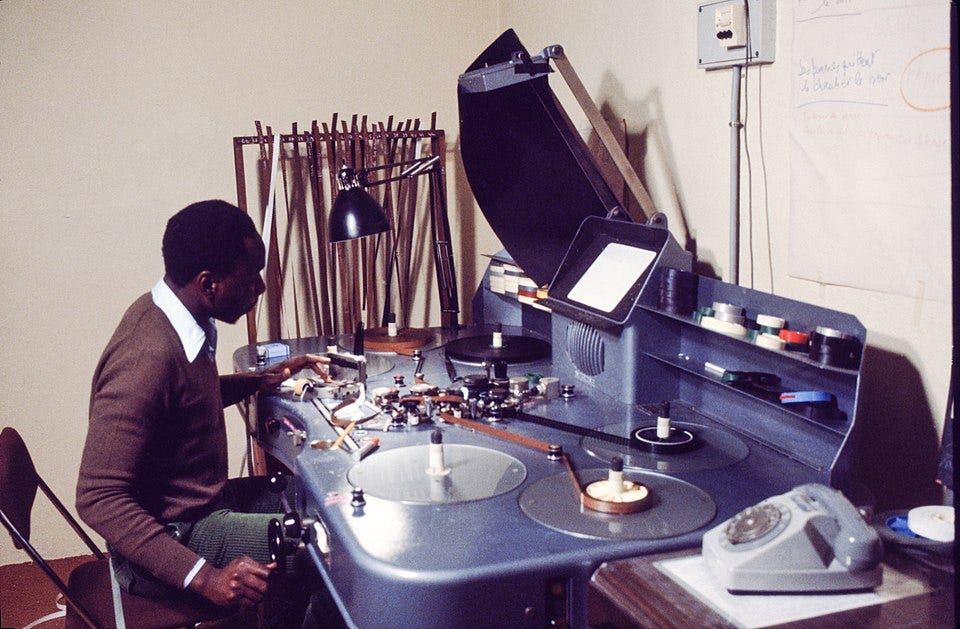

Decades ago, making a movie required a flat-bed editing machine. An editor would have to lay out reels and reels of film, slice them with razor blades, tape them together, scrub through them back and forth and back and forth. It was a strenuous process that required a small army of assistants, managers, and technicians.
Today, with modern computers, the process of editing a feature film can feasibly be completed by an editor with an assistant, and maybe a helpful producer or production manager clearing legal and licensing hurdles. Similar efficiency gains have revolutionized filmmaking across the board, from digital cameras, to LED lights, to digital and cloud-based paperwork for production and legal, and beyond.
The sheer shrinking of the cost of making a film is nothing short of a miracle. It should be easier than ever to make a buck, right?
As an artist, craftsman, or even just someone who wants to know that their work isn’t a waste of time, we want the films we make to reach their full potential; We want our films to reach everyone who find it valuable.
And as entrepreneurs, or at least as people who wish to make a living this way, we want to capture a commensurate share of the value our films make.
This is how I see the paradigm: even if a film is a bit niche, it still has value. Maybe there are 10,000 people around the world who would be willing to pay a ticket price to see it, and maybe 5,000 people who would be willing to purchase a DVD or digital copy, and maybe another 100,000 people would watch it on an ad-supported platform that pays some dividend to the filmmakers. And then throw in a few other avenues like merchandise and supportive patrons.
Aggregated together, that would be the film’s hypothetical total value, and maybe that could total out to $500,000. Not bad! It’s our challenge as the creators to find a way to distribute the film in such a way that its full value can be realized while managing costs and partnerships in order to capture some of that value so that we can have a sustainable career.
And I refuse to believe that this isn’t more possible in today’s day and age considering that we don’t have to edit on flatbed machines anymore. Independent filmmaking should be more dynamic and successful than ever, but it’s not.
The US film industry is producing fewer films and shows, and those films and shows are being built off of pre-existing IPs. If independent filmmaking was healthy, then we would expect to see more and more originals and independents punching far above their weight and to see the studios racing to platform them — but that is not the case. There may be more independent films as a raw total, but they are a miniscule part of the industry that the studios can’t even be bothered to even look at.
Why? Many people have put forth a diverse array of answers; maybe it’s the paradigm shift of the Chinese market, or the Millennials and their digital consumption habits. My answer is that the streaming business model is built to make us fail.
If you make a film, how many other people in the world have either the personal desire or the economic incentive to help make that film succeed? It used to be, say 10-20 years ago, that you could contract with a sales agent and they would do a lot of the heavy lifting; package your film, pitch it to networks, studios and distributors, work with VHS and DVD manufacturers, and advertise it in key markets. And what we took for granted in this model is that everyone involved, from the DVD makers to the networks and studios, to the distributors, theaters and advertisers, makes more money when more people see the movie.
In other words, everyone’s business model was aligned with success the success of the film.
That’s not how streaming platforms operate.

Here’s my totally scientific chart to explain the internal calculus of a subscription-based streaming platform.
As the filmmaker, we want people to watch our work.
A streaming platform doesn’t really care about that at all. They care about gaining, or at least retaining, subscribers. Whether they watch your movie at all does not result in additional revenue for them — in fact, watching content is actually a bit of a liability because every view results in having to pay more in royalties and licensing fees. If a show is wildly successful in terms of views, but does not contribute enough to the paying subscriber count, that’s actually a streaming platform’s worst-case scenario.
There may be some leeway for shows that can be treated as a loss-leader or brand-positioner for the platform, but I would imagine most films and shows fall into the category of being enjoyable and worthwhile watching to many people, but they’re not enough to make people want to punch in their credit card information for a monthly subscription.
The result of this is that so many movies and shows are being licensed for limited windows, or they’re pulled or canceled within only a couple episodes or seasons. And worse, there’s nothing the filmmakers or advertisers can do about it because gaining a viewership could actually be a bad thing.
For instance, did you notice that so many holiday movies are in the “Leaving Soon” category now that the Christmas season is done? Around December, you might sign up for a free trial if you really wanted to watch a couple of staple Christmas movies, but during any other time in the calendar year, there’s realistically no subscriber-count reason to keep the title on their platform as it will just be more royalty checks they have to cut.
And so we have a serious divergence in goals between the filmmaker and the major networks and studios that own the streaming platforms.
As a filmmaker, how are you supposed to succeed in this environment? How is it possible to both realize your film’s full value and also capture any of that value? Right now, if you go to a sales agent, they’re really just going to pitch you to the same streaming platforms as well. Very few, if any, are going to seriously consider a theatrical release, and home video is gasping for breath as fewer and fewer retailers even offer DVDs or BluRays.
The only remaining avenues for revenue capture that align with the success of the film would be ad-supported streaming and linear television, transactional video on demand (TVOD) and home video, and four-walling/theatrical.
Paid subscriptions directly to the creators (like SubStack and Patreon) or creating your own streaming service like through UScreen may also be a helpful revenue source, but I’m not certain if the incentives are all that aligned, still. For example, making a documentary vs making a narrative film with union labor would still put me on the hook for paying for royalties and bonuses in line with the viewership of the narrative in a way I wouldn’t with the documentary, and so now the revenue for subscription shifts to the hypothetical version of me that owns the streaming service, but so do the divergent incentives.
And so I feel like I’m at an impasse. In the coming years, for me to take my own career into my own hands will require I probably invest more into the actual business of distribution and marketing for my own works. It’s not exactly what I ever learned to do or wanted to take the reins of as I came up during the Streaming Wars and the media investment bubble of the 2010s — but it seems like the inevitable solution one must reach in such an uber competitive market — be able to market your own stuff.
post-script:
I know I just spent this post ragging on streaming services, but to clarify, I’m particularly pointing at the divergent incentives some streaming platforms have — the ones that are based on subscription fees to a fault while having to pay royalties and other benefits/rewards for viewership that otherwise does not result in enough marginal revenue to not be a burden. I do, however, have some of my works available for streaming and I don’t believe these face the same incentives.
A Clean Slate, streaming now on CIVL (free to watch)
The Long Ride Home, streaming now on HistoryFix ($5/mo, cancel anytime, perfect for history buffs! + a free trial is available)
An American Portrait, streaming now on Relay ($4.99/mo cancel anytime) and Filmzie (free)
[1] I can add a little bit of complexity to this in acknowledging that streaming platforms don’t exclusively get all of their revenue from subscription fees alone. Many have a cheaper, ad-supported subscription tier that might align incentives towards the film’s success in some way, but I think that would be far too optimistic. Ad-Supported Video On Demand (AVOD) makes up a very marginal share of revenue compared to Subscription Video On Demand (SVOD), on top of which one would still have to become a subscriber of the platform just to gain access to the title in the first place, and that action of becoming an AVOD customer is seen as only a precursor to eventually becoming an ad-free subscriber down the road. In other words, I don’t believe any streaming platform sees their ad-tier as their platform’s future, rather than just a helpful way for them to build their sales funnel to higher value extraction.

 | A guest post by
|
This was a truly insightful perspective and one I hadn't considered before. Thank you for sharing some insights to this market.